Microsoft Unveils Three New Foundational AI Models to Rival OpenAI and Google
Microsoft AI releases MAI-Transcribe-1, MAI-Voice-1, and MAI-Image-2, offering faster and cheaper multimodal solutions to compete with OpenAI and Google.
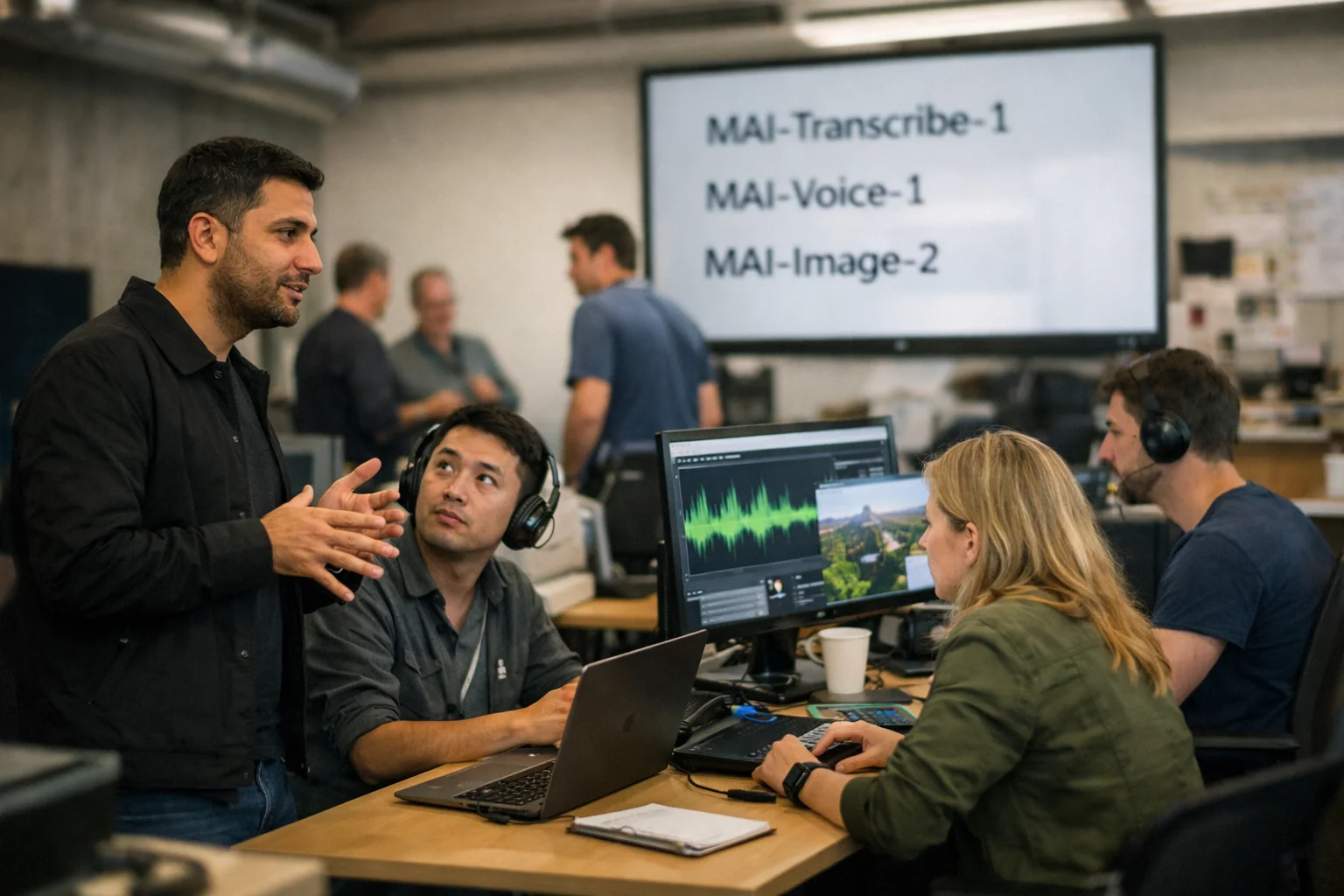
Key Points
- →Microsoft AI released MAI-Transcribe-1, MAI-Voice-1, and MAI-Image-2 to build its own independent multimodal stack.
- →The models were developed by the MAI Superintelligence team led by Mustafa Suleyman and are being positioned as cheaper alternatives to Google and OpenAI.
- →Despite the new internal models, Microsoft reaffirmed its commitment to its multi-year, multi-billion dollar partnership with OpenAI.
Key takeaways
- Microsoft AI released MAI-Transcribe-1, MAI-Voice-1, and MAI-Image-2 to build its own independent multimodal stack.
- The models were developed by the MAI Superintelligence team led by Mustafa Suleyman and are being positioned as cheaper alternatives to Google and OpenAI.
- Despite the new internal models, Microsoft reaffirmed its commitment to its multi-year, multi-billion dollar partnership with OpenAI.
What happened
Microsoft AI, the research lab led by Mustafa Suleyman, announced the release of three foundational AI models on Thursday. These models—MAI-Transcribe-1, MAI-Voice-1, and MAI-Image-2—are designed to generate text, voice, and video. This release marks a major push for Microsoft to develop its own multimodal AI stack, allowing it to compete more directly with rival labs while maintaining its existing ties to OpenAI. The models are being released on Microsoft Foundry and are partially available for testing in the new MAI Playground software.
Key details
The specific capabilities of the new suite are significant: MAI-Transcribe-1 handles 25 languages and is 2.5 times faster than current Azure offerings, starting at $0.36 per hour. MAI-Voice-1 allows for near-instant custom voice generation, and MAI-Image-2 serves as a video-generating model. Pricing for these models is intentionally competitive, with Microsoft explicitly stating they hope to attract users by offering lower costs than Google and OpenAI. The models were developed by the Superintelligence team, a specialized unit formed in late 2025 to optimize AI for practical human communication.
Strategic Shift
While Microsoft has invested over $13 billion into OpenAI, CEO Mustafa Suleyman reaffirmed the partnership's stability. However, he noted that a recent renegotiation has allowed Microsoft to pursue its own superintelligence research. This approach mirrors Microsoft's strategy in the hardware sector, where the company produces its own proprietary chips while simultaneously purchasing from outside suppliers. By developing internal foundational models, Microsoft is building a 'Humanist AI' focus that prioritizes practical use cases and cost-efficiency for enterprise clients.
Sources
Why it matters
This move signals a significant strategic shift where Microsoft is diversifying its AI portfolio to reduce reliance on OpenAI while building a vertically integrated stack.
Sources
Staff writer at TechCrunch AI
Related Articles